
Most people treat impostor syndrome like an infection—something to be diagnosed, managed, and eliminated.
But what if we’ve been thinking about it all wrong?
What if impostor syndrome isn’t a problem… but a portal?
You don’t feel like an imposter when you’re stagnant. You feel like one when you’re stretching—when you’re brushing up against the edges of your identity, testing the boundaries of what you thought was possible.
And isn’t that exactly where your next evolution begins?
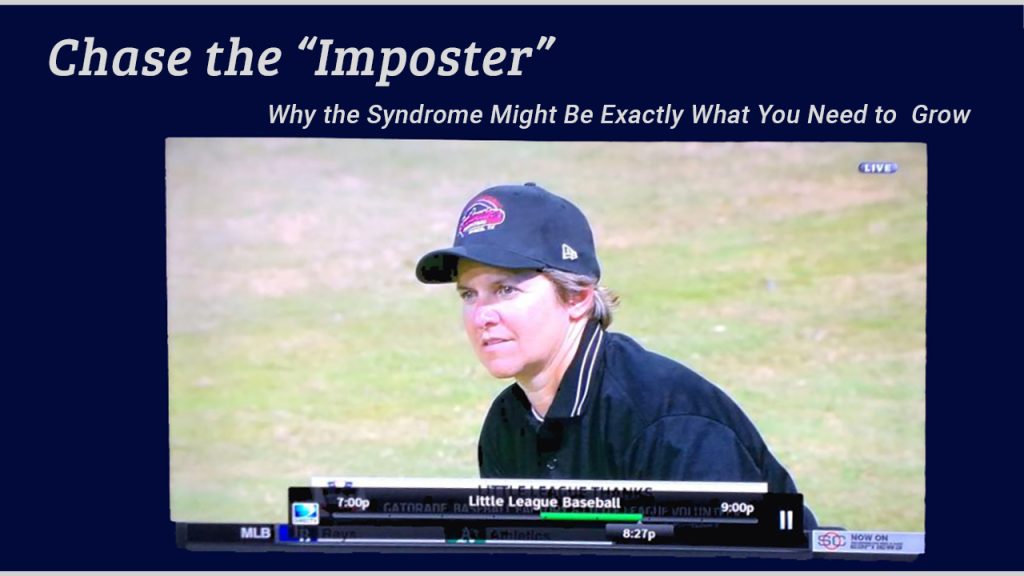
I felt it the day I got the letter from Little League to do my first Southwest Regional tournament in 2014.
After 11 years of volunteering as an umpire at the district, sectional, and state levels and dedicating summers to the game, I had finally been selected to umpire at the Regionals in Waco, TX. I’d finally get to live that lifelong dream of being on ESPN.
It should have been the ultimate validation. I was the first woman ever to umpire the Little League Baseball Southwest Regional tournament.
But as I sat in our first meeting, looking around the room at some amazing umpires (with more experience than me), my heart wasn’t just pounding from excitement.
It was doubt.
- “What if I mess up on national TV?”
- “What if I don’t belong here?”
- “What if I was chosen because they needed a woman, not because I earned it?”
I’d given a lot to be there. And still, that voice came.
It wasn’t fraud. It was friction.
The beautiful resistance of becoming someone my past self couldn’t have imagined.
That’s when I realized: Imposter syndrome doesn’t mean you’re out of place. It means you’re in motion.
Imposter Syndrome: A Signpost, Not a Sickness
The word syndrome comes from the Greek sundromē: sun- meaning “together” and dramein, “to run.”
So what if imposter syndrome isn’t just a bundle of symptoms?
What if it’s you and your future self running together?
Maybe your future self is faster. Stronger. Wiser. More refined. But they’re not outrunning you—they’re inviting you forward. You’re not behind. You’re becoming.
That ache in your chest? That uncertainty? That voice saying, “Who am I to be doing this?”
That’s not fraud.
That’s friction—the friction of transformation. The beautiful resistance that comes from stretching beyond your old limits into someone new.
You Only Feel Like an Imposter When You’re Growing
Imposter syndrome shows up at the intersection of courage and growth. It’s not a signal to stop—it’s proof you’re on the right path.
You don’t feel like an imposter when you’re playing small.
You feel it when you dare to dream bigger than your past identity can validate. When your current self laces up and starts sprinting after your future.
Yes, it’s uncomfortable. But it’s also sacred.
Because if you never feel like an imposter, it might mean you’ve stopped running.
The Real Danger? The Absence of Imposter Syndrome.
If you haven’t felt like an imposter in a while, it might be a red flag ????.
It might mean you’re stuck in success. You’re repeating patterns that no longer stretch you. You’re performing in an identity that doesn’t require growth—just consistency.
Comfort, not challenge, is the real enemy of growth.
Imposter syndrome isn’t the cost of success. It’s the currency of growth.
It’s the emotional signature that says, “I’m not who I was… and I’m not yet who I will become.”
Let the Tension Pull You Forward
You’re not trying to deceive anyone.
You’re trying to become someone you’ve never been.
So the next time that voice whispers, “You don’t belong here,” smile and respond:
“Not yet. But I’m becoming the person who does.”
Want to Explore This Tension Live?
If this resonated, I’m diving deeper into these identity-level shifts in an upcoming masterclass:
The Illusion of Enough: Why Leaders Get Stuck and What to Do Instead
- ???? Wednesday, May 7th at 4:00pm
- ???? For successful leaders quietly craving more
- ???? To register, go to https://traciduez.com/masterclass.
This isn’t about imposters. It’s about becoming.
Join us by going to https://traciduez.com/masterclass.