
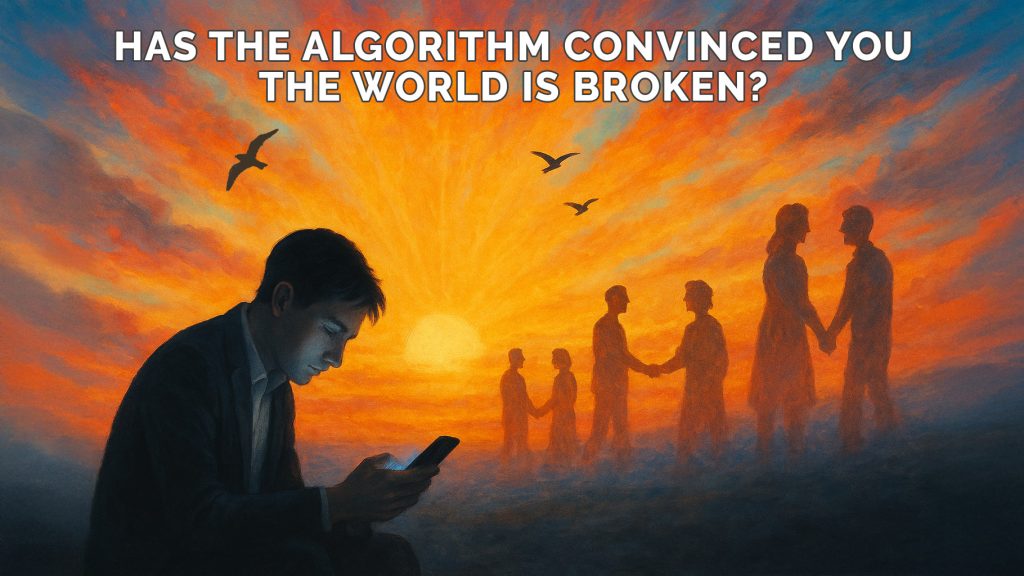
What You Choose to Believe Shapes Everything You Become
Do you remember the last time you scrolled through your feed and felt genuinely hopeful about humanity?
If you’re struggling to recall that moment, you’re not swimming upstream alone. The algorithms feeding us content have figured out that:
- Outrage keeps us scrolling longer than inspiration.
- Fear gets more clicks than faith.
- Division drives more engagement than unity.
And somewhere along the way, many of us started believing that’s actually how the world is.
The Weight You’re Carrying That Isn’t Yours
You feel it, don’t you? That heaviness that settles in your chest when you watch the news or read the comments. The way your shoulders tense when another story breaks about humanity’s failures. The exhaustion that comes creeping in from the thought that maybe the pessimists are right—maybe we’re all just selfish, broken, and getting worse.
I carried that weight for years. Standing behind home plate at youth baseball games, I had a front-row seat to humanity at its most unguarded. Parents screaming at their kids. Coaches berating young players over a missed catch. Spectators turning ugly over a game that’s supposed to be about joy.
It would have been easy to conclude that people are fundamentally small-minded and selfish.
Instead, I started paying attention to something else.
The parent who quietly encouraged the kid who struck out. The coach who pulled a struggling player aside—not to criticize, but to remind him that he believed in him. The teenager who helped pick up the garbage around the stands without being asked. The grandparent who drove three hours just to watch their grandchild play two innings.
Same field. Same games. Completely different story, depending on where I chose to focus my attention.
The Power of Your Gaze
Every day, you get to decide which story you’re going to author about the human experience. You get to choose what evidence you collect about who we are and who we’re becoming.
But most people have surrendered this choice without realizing it. They’ve let the loudest, angriest voices convince them that cynicism is realism. That expecting the worst is just being smart. That hope is naive.
Are you open to another perspective? Those billions of neural pathways in your brain that determine your personal reality—who’s the principal architect? Is it you? Or are you comfortable relinquishing control of your reality to forces outside yourself, particularly considering what’s at stake: namely, your life?
The construction worker I know who brings coffee for his whole crew every Friday isn’t making the evening news. The executive who took a pay cut so her team could keep their jobs won’t trend on social media. The neighbor who shovels your driveway without mentioning it doesn’t generate headlines. A business traveler dining alone overhears an elderly couple sharing one coffee because they can’t afford two—and quietly pays their bill, adding dessert for both, isn’t awarded a medal.
These aren’t isolated incidents of goodness in a sea of darkness. They’re glimpses of what’s actually happening all around us, all the time, when we choose to look.
Your Agency in This Story
Most people don’t intentionally give their power away. It happens gradually—one compromised belief at a time, one disappointed expectation after another, until they wake up one day having traded their agency for the comfort of resignation.
While others resign themselves to worry, criticism, and sideline commentary, you have a different option.
You can choose to believe that humanity’s star is rising. You can decide that most people, given the chance, will choose connection over division, contribution over consumption, hope over fear.
This isn’t about ignoring reality or pretending problems don’t exist. This is about recognizing that your beliefs about people become the lens through which you see everything—and that lens shapes not just what you notice, but how you show up in the world.
When you believe in human goodness, you extend the benefit of the doubt instead of assuming the worst. You ask questions instead of making accusations. You offer help instead of criticism. You become someone others can count on instead of someone who’s constantly disappointed.
And in choosing to be that person, you add one more piece of evidence to the case for human potential.
The Freedom to Choose
Think about your last interaction. What story did you tell yourself about their intentions? What assumptions did you make based on your lens?
This choice—what to believe about humanity—might be the most fundamental freedom we have.
- No algorithm can make it for you.
- No pundit can decide it for you.
- No tragedy, however heartbreaking, can take this power away from you.
You can choose to believe we’re getting worse, that people are fundamentally selfish and greedy, that the future is bleak. That choice – YOUR choice – will color every interaction you have, every decision you make, every relationship you build.
Or you can choose something else entirely.
You can choose to believe that most people are doing the best they can with what they have. That kindness is more common than cruelty, even if it’s quieter. That the human capacity for growth, connection, and contribution is expanding, not contracting.
Where This Leaves You
Every morning when you wake up, you get to decide which version of humanity you’re going to look for today. You get to choose whether you’ll add to the voices of despair or become evidence of hope.
The world doesn’t need another critic sitting safely on the sidelines. It needs people who refuse to give up their power to choose—who won’t let the loudest, angriest voices convince them that’s all there is.
What do you choose to believe about the people sharing this planet with you? About the trajectory we’re on? About your role in that story?
Because that choice doesn’t just shape how you see the world. It shapes how you show up in it. And how you show up determines what kind of world we’re all creating together.
This week, try asking “What does this moment need from me?” instead of “How do I handle this?”
Let’s see what a difference we can make.
What shift in how you see humanity might change everything about how you move through your days? I’d love to hear your thoughts.